
Building a Batch Record Chain for an Influencer Launch
A batch record chain is not a document; it is a sequence of records where each one identifies the next. Built properly, it lets a brand answer a question about a single bottle months after the launch, using only the file. Built informally, it produces a folder of emails that proves nothing. The steps below are the order in which the chain should be constructed, because each step depends on the one before it.
Key takeaways
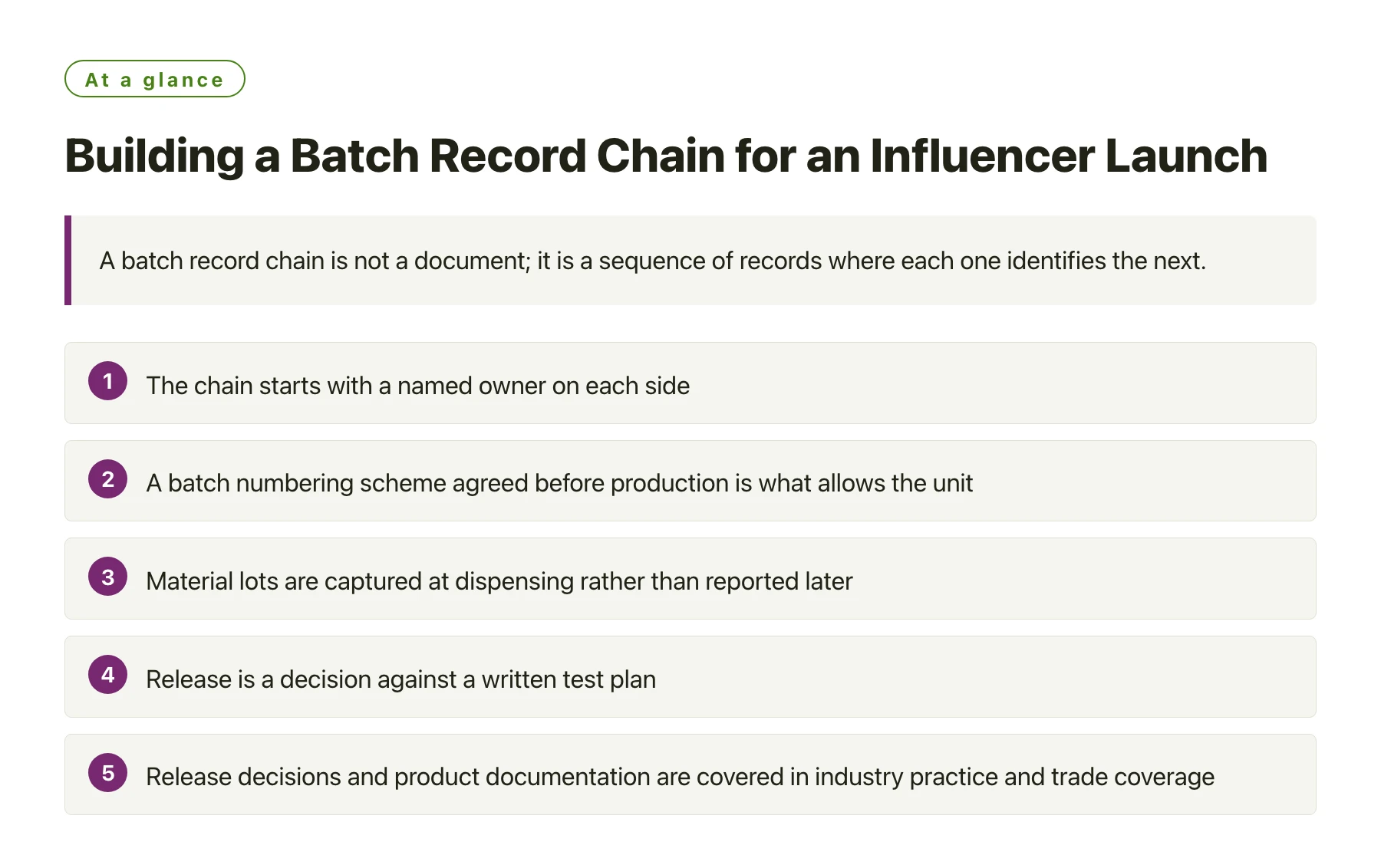
- The chain starts with a named owner on each side, because records that belong to nobody are collected inconsistently and retrieved slowly.
- A batch numbering scheme agreed before production is what allows the unit, the material lots and the test results to be linked to one another.
- Material lots are captured at dispensing rather than reported later, since that is the only point where the physical material and the record are in the same place.
- Release is a decision against a written test plan, not the moment the pallet is ready, and the two should never be merged.
- Release decisions and product documentation are covered in industry practice and trade coverage, which is a useful way to see how expectations evolve over time [1].
- Testing scope can be defined with a third-party laboratory, and providers publish what they cover so the plan can be written around the launch rather than after it [2].
Fast launches put pressure on documentation because everything happens at once: artwork, sampling, production, shipping and marketing. The chain described here is designed to be built in that environment, using small records produced at the moment they are needed rather than a large retrospective file.
It is written for an operations lead who owns quality on a small brand and needs a method that a factory can follow without being asked to change its own systems.
The seven steps in order
- Step 1: Name the record owner on each sideOne person at the factory and one at the brand, each responsible for issuing and for collecting. This is the step that makes the other six possible.
- Step 2: Agree the batch numbering schemeThe code must link a unit to a compounding event and remain stable across reorders. Test it against a second order before adopting it.
- Step 3: Capture material lots at dispensingThe dispensing record names each material, its lot number and the quantity used. This is the evidence behind any ingredient claim.
- Step 4: Tie the reference sample to the batchIf the approved sample is a bench sample, record that fact. Attach the approved sample code to the production batch so the comparison is explicit.
- Step 5: Record compounding and filling as they happenParameters written during production describe what happened; parameters written afterwards describe what was intended.
- Step 6: Release against the written test planThe test plan is agreed before production starts, and release follows the results. A pallet that is ready is not the same as a batch that is released.
- Step 7: Retain, archive and hand overRetained units, the assembled record set and the archive location are agreed with a named holder and a retention period.
What each record must be able to answer
| Record | The question it answers | Typical failure |
|---|---|---|
| Dispensing record | Which materials, from which lots, went into this batch | Quantities recorded, lot numbers omitted |
| Compounding log | What process was followed, and did anything deviate | Written from memory at the end of the shift |
| Filling and packing record | Which units came from which bulk and when | Record keyed to the order rather than the batch |
| Test summary | What was checked, on which sample, with what result | Results present, sample identity absent |
| Release decision | Who approved the batch for shipping, and on what basis | Release implied by the shipping date |
| Retention record | Where a comparable unit is stored, and how it was kept | Samples kept, storage conditions unknown |
Each failure in the third column is a record that exists but cannot answer its own question. The chain is only as strong as the weakest of the six.
Why the order of the steps matters
Steps two and three are frequently reversed, and the result is a set of batch numbers that cannot be linked to materials. Agreeing the scheme first means every later record has a place to belong.
Steps four and five are frequently merged, on the assumption that production will reproduce the approved sample automatically. Recording the difference between a bench sample and a production batch is not an admission of a problem; it is a description of reality, and it makes a later comparison honest.
Step six is the one most often skipped in a fast launch, because the goods are ready before the paperwork is. Release is a decision, and separating it from availability protects the brand from shipping a batch that has not been cleared.
Step seven is where the chain either becomes useful or becomes archaeology. A record set handed over at delivery, with a named holder and a retention period, is usable. A set left in a shared drive without an owner is not.
The whole sequence is a system rather than a document, which is why it is worth confirming that a partner actually operates one. A manufacturer that describes itself as a 31-year-old fragrance manufacturer in China has had many years to build such a system, but the same questions apply to any partner: who owns the records, how are they keyed, and how are they retrieved?
Adapting the chain to an influencer launch
An influencer launch has three specific pressures. The first is speed: the audience is already waiting, so the record work is competing with marketing work for attention. The second is reorders: a successful drop is often followed by a second production run within weeks. The third is replacements: individual units go back to customers, and each one should be traceable.
The reorder pressure is the strongest argument for a stable numbering scheme. If the second run cannot be distinguished from the first, a complaint about one becomes a question about both.
The replacement pressure makes retention samples more valuable, not less. When a single unit is returned, the most useful comparison is against a retained unit from the same batch, tested under the same conditions.
It is also worth writing the release step into the launch timetable as a real milestone. If the drop date assumes shipping on the day the goods are packed, release will be compressed exactly when it should be most careful.
Before signing, the record questions belong with the other commercial checks. The matters covered when reviewing the checks that matter before signing a contract are the right place to confirm who holds which record, because the answer is much harder to change once production has started.
For brands building a premium position, the same logic applies with higher stakes, since a quality failure on a high-priced line is expensive to repair. The quality expectations described for premium fragrance OEM and QA are a useful reference for what the record chain is ultimately protecting.
Finally, the partner's own background is worth reading before the brief, not after. Reviewing its background and certifications is not a substitute for asking about records, but it does show whether a factory presents certification and process as a system or as a list of logos.
Test the chain before the launch, not after. Pick one finished unit at random and try to answer five questions from the file alone: which batch, which materials, which process, which test, who released it. Any question you cannot answer is a step that was skipped.
Sources
- Cosmetics & Toiletries —— A technical magazine for cosmetic formulators, covering ingredients, formulation science and testing methods.
- SGS: Cosmetics, Personal Care & Household Testing —— Testing, inspection and certification services for cosmetics and personal care, including microbiological, stability and safety testing aligned with cosmetics GMP.
Frequently asked questions
Who should own the batch records, the brand or the factory?
Both, with a named person on each side. The factory generates most of the records during production, while the brand holds the approved specification and the commercial history. The handover at delivery is what makes the two halves one file.
What is the simplest workable batch numbering scheme?
One that identifies the production date and the bulk batch in a stable format, and that remains meaningful on a reorder. The test is whether a unit code can be traced back to a material lot list without asking anyone to interpret it.
Is release testing required for every batch?
The required tests depend on the product and the market, which is why a written test plan matters more than a general commitment to testing. The plan should state which checks are performed per batch and which are performed once per formula or per component lot.
How do we handle a substitution during production?
With a written deviation note and a decision. The note records what changed, why, and what the effect is expected to be. If the substitute touches the ingredient position, it also requires a check against the exclusion list before release.
How long should the record chain be kept?
Longer than the product can realistically be sold and used, so that a late complaint can still be investigated. The retention period should be agreed with the factory rather than assumed, because the factory may hold records for a shorter default period.
Bring the harvest home
320+ varieties grown on our 580-acre family farm. CSA shares available for the season ahead.
Join the CSA