
App Alerts for a 125 TH/s Mining Setup
An alert is only useful if someone acts on it. On a small mining setup with more than one person involved, the harder question is not whether the app can notify you but who is expected to respond. At 125 TH/s, current conditions produce 5.608e-05 BTC a day, worth $4.75 at $84,692 per BTC, or $4.56 after the listed 4% on the block-reward component.

Key takeaways
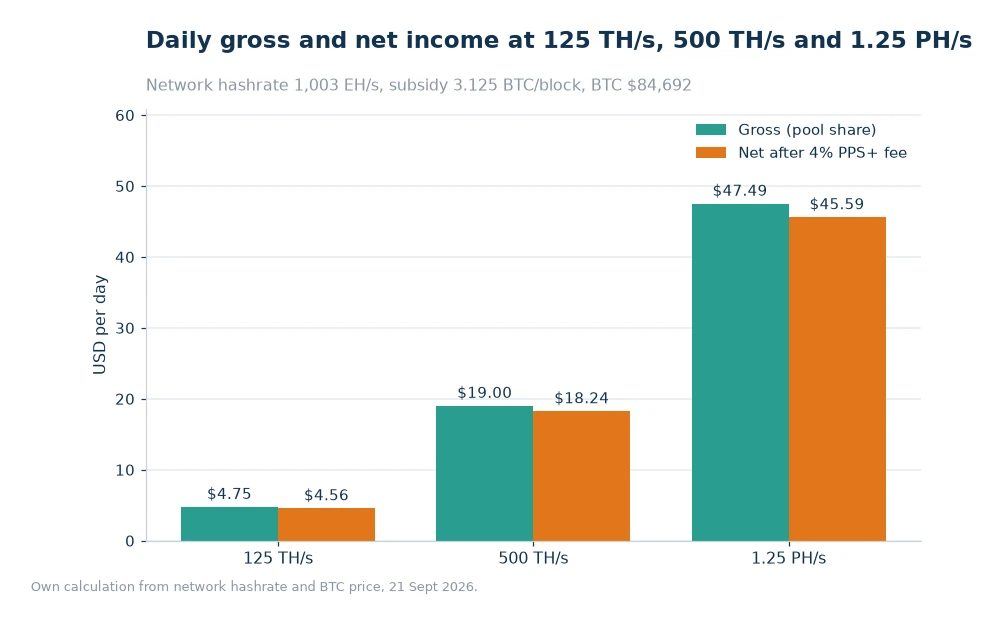
- At 125 TH/s, daily output is 5.608e-05 BTC, or $4.75 gross and $4.56 net of the listed 4% on the block-reward component.
- At 1.25 PH/s the same inputs give 0.00056076 BTC a day, $47.49 gross and $45.59 net.
- The ViaBTC App provides real-time hashrate monitoring, alerts and multi-account management on iOS and Android.
- Assign a responder before assigning a threshold, or the alert becomes background noise.
Alerts are a handover tool
A one-person operation can keep the state of a rig in their head. A two-person operation cannot, and a small group with a shared site definitely cannot. The alert becomes the handover: it says the rig was hashing when the last person left and it is not hashing now. Without that, the second person arrives to a silent room and has to reconstruct what happened from the pool balance.
The handover works only if the alert has an owner. A notification that goes to three phones can end up being ignored by all three. Pick one person per shift or per day, tell them what the threshold means, and give them the first action: check the app, then check the machine, then call the other person. That sequence is more useful than a longer list of settings.
What the download gets you
The ViaBTC App Download page has the iOS and Android builds. The app provides real-time hashrate monitoring, alerts and multi-account management, which covers the three things a small shared setup needs: a live number, a warning when the number changes, and a way to see more than one account without signing in and out.
It is worth installing on the phones of the people who will actually respond, not only on the owner's phone. An app on a phone that is never checked is a dashboard with extra steps. The point of the download is to put the hashrate in front of the person who can walk to the rig, which is often not the person who bought it.
Three sizes and the cost of silence
The table gives each size a daily figure so the cost of an unnoticed outage can be estimated. The rows step by a factor of four and then 2.5, and the net column applies the listed 4% to the block-reward component. Power is excluded because the app does not measure it.
| Hashrate | BTC per day | Gross USD per day | Net USD per day |
|---|---|---|---|
| 125 TH/s | 0.00005608 | $4.75 | $4.56 |
| 500 TH/s | 0.00022433 | $19.00 | $18.24 |
| 1.25 PH/s | 0.00056076 | $47.49 | $45.59 |
At the first row, a day of silence costs about $4.56 of net output before saved power. At the top row it costs about $45.59, which is enough to justify a phone call rather than a note in the group chat. The same alert threshold can be right for both if it is set at the loss of one machine, but the escalation should depend on the size of the site.
Choosing what to be told
Three alerts cover most small setups: hashrate below the expected figure for a sustained period, an account balance that has not moved when it should have, and a machine that has gone offline. The first is the earliest signal, the second catches a pool-side issue, and the third is the most direct. Too many additional alerts dilute all three.
A balance alert needs care because PPLNS and PPS+ behave differently. PPS+ settles hourly against current difficulty, so a missed payment is visible quickly. PPLNS settles after 6 confirmations and shares the last 5 difficulty rounds, so a quiet balance for a few hours can be normal. Set the balance alert with the settlement method in mind, or it will fire on a schedule that the pool never promised.
When the alert is not the problem
Sometimes the alert is accurate and the response is the problem. A rig that trips the same breaker every afternoon is not fixed by a notification; it needs an electrician. A machine that derates at midday needs airflow, not a higher threshold. The alert is a symptom detector, and treating it as the fix is how a small issue becomes a repeating one.
Keep a short log beside the app: date, alert, action, result. After a month the log shows whether the same event keeps recurring and whether the response is working. That is more valuable than a longer list of notification settings, because it turns the alerts into a maintenance record rather than a stream of interruptions.
Worked example
Take 125 TH/s and run the chart arithmetic with the inputs read on 21 Sept 2026.
- Daily BTC per TH/s is 450 divided by 1,003,000,000, which equals 4.4865e-07.
- Multiply by 125: 4.4865e-07 times 125 equals 5.6081e-05 BTC, shown as 5.608e-05.
- Multiply by the BTC price: 5.6081e-05 times $84,692 equals $4.75 gross.
- Apply the listed 4% to the block-reward component: 4% of $4.75 is $0.19, leaving $4.56 net.
- Multiply by four for 500 TH/s: 0.00022433 BTC, $19.00 gross and $18.24 net.
- Multiply by ten for 1.25 PH/s: 0.00056076 BTC, $47.49 gross and $45.59 net.
- Thirty days at 1.25 PH/s nets about $1,367.70 before power, which is the exposure a sustained unattended outage puts at risk.
Give the responder the context
The person on call needs more than an alert; they need the expected number. A link to the Statistics page gives them the network and pool context, and a one-line note in the group gives them the normal hashrate for the site. With those two pieces, an alert becomes a decision rather than a question.
Write the threshold, the owner and the first action in the same place. At 125 TH/s the daily net is $4.56 before power, so the cost of a slow response is easy to state. A setup that knows what silence costs is a setup that will answer the alert.
Frequently asked questions
Who should receive the app alerts?
The people who can physically reach the rig, not only the account owner. Alerts work as a handover tool when the responder knows the expected hashrate and the first action to take.
How much output is lost in a day offline at 125 TH/s?
About 5.608e-05 BTC, or $4.56 net of the listed 4% on the block-reward component at $84,692. Power would not be consumed during the outage, so the net loss is somewhat lower than the revenue figure.
Does a balance alert work the same for PPS+ and PPLNS?
No. PPS+ pays hourly against current difficulty, so a missed payment is visible quickly. PPLNS pays after 6 confirmations across the last 5 difficulty rounds, so a quiet balance for several hours can be normal.
Name the owner, then set the threshold
Pick the person, the number and the first action. At 125 TH/s the number is 125 TH/s and the daily net is $4.56 before power. If the alert fires, the responder checks the app, walks to the rig and logs what they found. That routine is worth more than any additional notification setting, because it turns a signal into a repair.
Sources: the ViaBTC download page for the iOS and Android app, and the pool fee schedule for the listed rates. Network hashrate 1,003 EH/s, difficulty 132.76 T, subsidy 3.125 BTC per block, 450 BTC daily and BTC $84,692 were read 21 Sept 2026, published 22 Oct 2026[1]. Every dollar figure is arithmetic on those inputs and moves when they move.